Pakistan’s Implosion: A Crisis of Choice, Not Circumstance
- Amit Kumar
- Jan 20
- 3 min read

The Myth of Victimhood
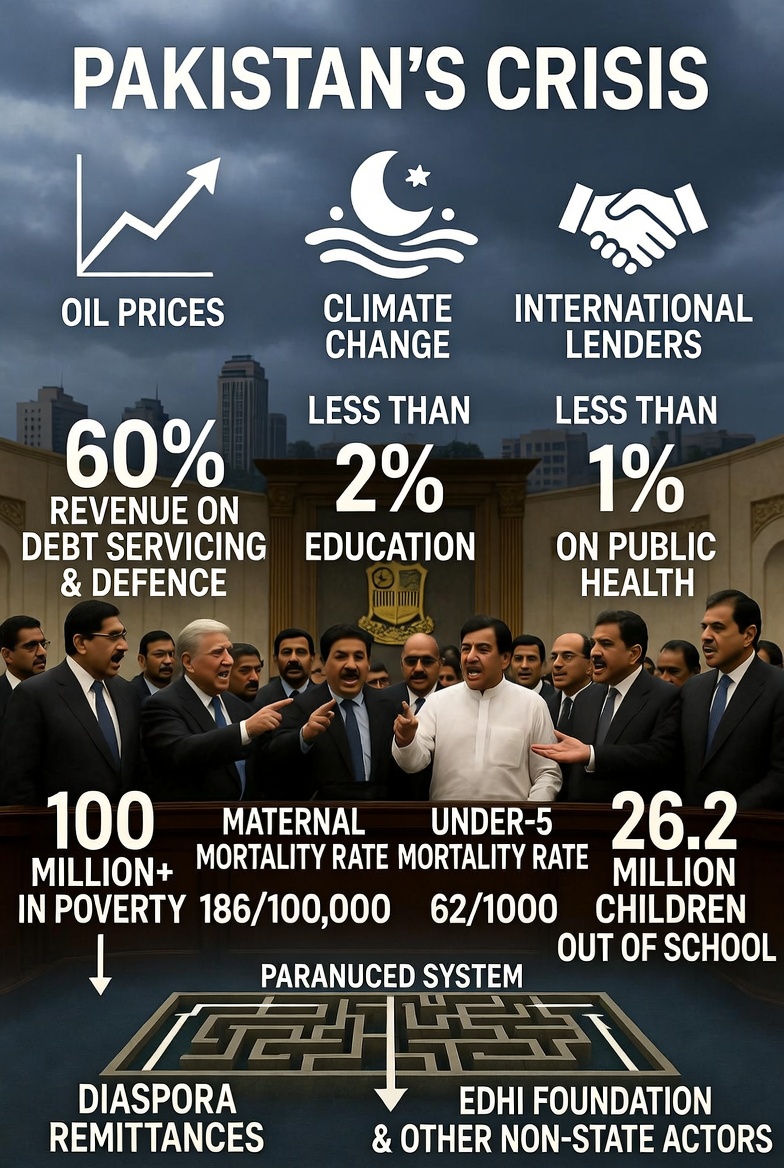
In the corridors of power in Islamabad, a convenient narrative is constantly replayed. The economic collapse of the nation is painted as a tragedy of external circumstances. The leadership points fingers at global oil prices, the aftermath of climate-induced floods, or the stringent conditions of international lenders. The story told to the world is simple: Pakistan is a victim of bad luck and harsh geopolitics.
But facts do not support this alibi.
The crisis unfolding in Pakistan is not imported; it is indigenous. It is not the result of what the world has done to the country, but what the state has deliberately done to itself. We are witnessing a collapse that is structural, systemic, and entirely self-inflicted. It is the mathematical inevitability of a decades-long policy that prioritized "Strategic Depth" over human survival.
The Budget of a Security State
To understand the rot, one does not need to look at political speeches, but at the federal budget. A national budget is a moral document; it reflects the soul of a state. And Pakistan’s budget reveals a terrifying reality.
Today, the Pakistani state functions essentially as a debt-servicing agency with a military attached to it. Approximately 60% of federal revenue is consumed by just two heads: Debt Servicing and Defence.
This is the structural deadlock. Before the government spends a single rupee on a school, a hospital, a clean water project, or infrastructure, more than half of its income is already gone. The "Security State" eats first. The 240 million citizens eat last if anything is left at all.
And what is left? Crumbs. The state allocates less than 2% of its GDP to education and less than 1% to public health. This is not fiscal tightness; this is criminal negligence. It is a deliberate choice to prioritize the security of borders over the security of the people living within them.
The Human Consequences of Policy
When a nuclear-armed state abandons its social responsibility, the result is a humanitarian disaster disguised as a sovereign nation. The macroeconomic indicators have now bled into the streets.
The numbers are damning. Over 100 million people nearly half the population are now categorized as poor or highly vulnerable. The progress made in poverty reduction between 2017 and 2018 has been completely reversed.
But the most tragic metric is not the falling rupee; it is the falling life expectancy.
The Maternal Mortality Ratio stands at over 180 deaths per 100,000 live births.
The Under-5 Mortality Rate is the worst in South Asia.
While the state upgrades its arsenals, mothers are dying in childbirth at rates comparable to war zones. This is the price of military primacy. The obsession with hard power has eroded the nation's soft power its own people.
A Future Compromised
Perhaps the most alarming indicator for any observer of regional stability is the state of education. Pakistan is breeding a lost generation.
Currently, 26.2 million children are out of school. This is not just a statistic; it is a demographic time bomb. Even among those in school, "Learning Poverty" is rampant, with 77% unable to read and understand a simple text by the age of ten.
A state that cannot educate its youth cannot build an economy. It can only export unskilled labor or import instability. With youth unemployment rising and 60% of the workforce trapped in the informal sector, the state has abdicated its role as an enabler of the future.
The Illusion of Functionality
If the state has failed so comprehensively, how does the country survive?
It survives because the people have built a parallel system to bypass the state.
The economy is kept afloat not by industrial output, but by the $25-30 billion in annual remittances sent by the diaspora. This money acts as a de facto private welfare system, funding household consumption and healthcare.
Where the government is absent, philanthropy has stepped in. The destitute rely on non-state actors like the Edhi Foundation or religious seminaries (Madarsas) for food and shelter. The state has effectively outsourced its responsibilities to its citizens and charities, while retaining the monopoly on resources for the elite.
Conclusion: The Structural Flaw
The world often treats Pakistan’s crisis as a liquidity issue, solving it with loans and bailouts. But you cannot fix a structural flaw with a cheque.
Pakistan’s crisis is rooted in a fundamental imbalance: The resources of the state are monopolized by the security apparatus, while the burdens of the state are shouldered by the common citizen.
Until this equation is reversed until the budget prioritizes the child in the classroom over the soldier in the barracks the crisis will continue. No amount of external aid can fill a bucket that has a hole in the bottom.


Comments