BEYOND THE NOISE: Is India a Big Brother or the Ultimate Growth Partner? The Untold Reality of Bangladesh Best Ally
- Amit Kumar
- Feb 6
- 5 min read

In the geopolitical echo chambers of South Asia a new and rather noisy narrative is being constructed on the streets of Dhaka and in the corridors of social media. The slogan India Out is trending and certain political factions are working overtime to paint New Delhi not as a friend but as a domineering Big Brother who only looks out for its own interests. They argue that India suffocates Bangladesh and that the relationship is one of inequality and exploitation. But in the world of international relations noise does not equal facts and slogans do not change geography. If we strip away the emotional rhetoric and look at the cold hard data of economics and trade a completely different picture emerges. The reality is that India has never tried to be a Boss but has consistently acted as a Growth Partner. While the world looks at Bangladesh as a rising economy few acknowledge that the silent engine powering this rise is often Indian cooperation. Today we need to look beyond the headlines and examine the solid pillars of trade energy and crisis management that prove India is empowering Bangladesh not exploiting it.
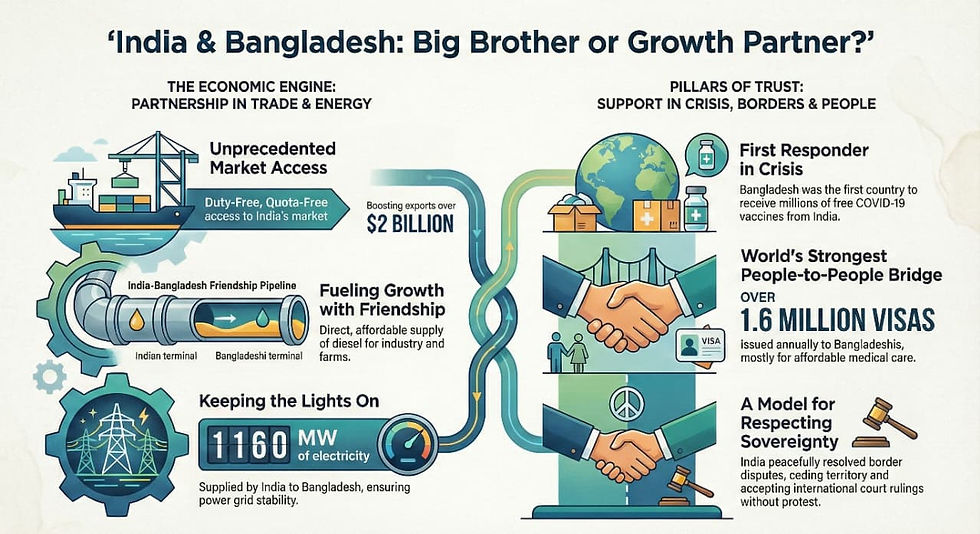
Let us begin with the most fundamental aspect of any relationship which is trade. Critics often complain that India floods the Bangladeshi market with its goods but they conveniently ignore the unique privileges New Delhi has extended to Dhaka. Under the South Asian Free Trade Area or SAFTA India has granted Bangladesh Duty Free Quota Free access to its massive market. This is a game changer that very few major economies offer. What this means in practice is that a Bangladeshi trader whether they are selling high end Jamdani sarees jute products or readymade garments can export their goods to India without paying a single rupee in tax. This is not the behavior of a protectionist Big Brother but rather the action of an economic partner willing to open its own doors to ensure shared prosperity. The result of this policy is visible in the numbers as Bangladesh’s exports to India have crossed the significant milestone of two billion dollars in recent years. If India wanted to dominate it would have erected trade barriers to protect its domestic textile industry but instead it lowered the drawbridge allowing small and medium enterprises in Bangladesh to thrive. This is not exploitation it is the very definition of economic empowerment.
Moving beyond trade we must address the lifeline of any modern nation which is energy. When the war in Ukraine sent global oil prices skyrocketing and nations across the world scrambled to secure fuel India did not just look out for itself. It extended a helping hand to its neighbor through the India Bangladesh Friendship Pipeline. This project which connects Siliguri in West Bengal to Parbatipur in Bangladesh is a logistical marvel that fundamentally changes how Dhaka secures its fuel. Before this pipeline Bangladesh had to rely on expensive and slow rail wagons to transport diesel which often led to shortages and high costs. Now clean and affordable diesel flows directly across the border fueling the textile factories that are the backbone of Bangladesh’s economy and powering the irrigation pumps for millions of farmers. Furthermore when Dhaka faces crippling power cuts during peak summer months it is often Indian electricity that keeps the lights on. Currently India supplies over 1160 megawatts of power through its grid including from the Adani Godda plant which was commissioned specifically to supply electricity to Bangladesh. This energy partnership is not about charity it is a strategic decision to ensure that the industrial wheels of a neighbor keep turning even when the global energy market is in chaos.
The true test of any friendship however is not when things are going well but when disaster strikes. We must look at India’s role as a First Responder during crises. In 2021 when the world was in the grip of the COVID 19 pandemic and rich Western nations were hoarding vaccines India operationalized its Neighborhood First policy with unprecedented generosity. Dhaka was the first recipient of Vaccine Maitri receiving millions of doses as a gift to kickstart its vaccination drive. This happened at a time when India itself had a massive domestic demand yet New Delhi prioritized the health security of its neighbor. This pattern of support is visible every time a natural calamity hits the region. Whether it is a cyclone battering the coast or floods devastating the hinterland Indian disaster response teams and relief materials are often the first to arrive at the border. Even in the volatile market of food security when India imposes export bans on essential commodities like onions and rice to control domestic inflation it frequently carves out special exceptions for Bangladesh. These are not the actions of a hegemon but of a partner who understands that a hungry neighbor is a dangerous proposition and that stability is a shared asset.
Beyond the government to government interactions the most powerful bond between the two nations lies in the people to people connection. It is a little known fact that India issues more visas to Bangladeshi citizens than to any other nationality in the world. Every year over one point six million people from Bangladesh cross the border not just for tourism or education but for life saving medical treatment. Hospitals in Kolkata Chennai and Vellore have become the primary destination for Bangladeshi patients seeking affordable and high quality healthcare. India has streamlined the medical visa process recognizing that borders should not become barriers when a human life is at stake. If the narrative of India being a domineering bully were true the borders would be sealed. Instead we see the Mitali Express and bus services running full capacity bridging the distance between hearts and minds. This human bridge is the strongest rebuttal to any anti India propaganda because it is built on trust and necessity.
Finally we must address the issue of sovereignty and respect which is often the flashpoint for nationalist rhetoric. In a world where powerful nations often use border disputes to bully smaller neighbors India has set a global precedent for resolving conflicts with dignity. The 2015 Land Boundary Agreement stands as a historic example of diplomatic maturity. India voluntarily exchanged enclaves and ceded territory to settle a complex border issue that had lingered for decades giving citizenship and identity to thousands of stateless people. This was resolved without a single bullet being fired. Similarly when the maritime boundary dispute regarding the Bay of Bengal was taken to the Permanent Court of Arbitration and the verdict went in favor of Bangladesh India accepted the ruling without appeal. A Big Brother would have flexed its military muscle or ignored international law but India chose to respect the sovereignty of its neighbor. This proves that New Delhi views Dhaka as an equal partner worthy of respect not a subordinate state to be dictated to.
In conclusion the noise of the India Out campaign might serve the political interests of certain radical factions but it cannot change the ground reality. Geography is destiny and the destinies of India and Bangladesh are irrevocably intertwined. India has chosen a path of developmental partnership building bridges pipelines and power plants rather than debt traps. Those who label India as a bossy neighbor are deliberately ignoring the facts to peddle a dangerous agenda. The truth is that when the global economy falters or when a crisis looms India stands as the only reliable safety net for Dhaka. This relationship goes beyond diplomacy it is a partnership of equals and a bond of trust. It is high time we discard the Big Brother lens and recognize India for what it truly is which is Bangladesh’s most reliable Growth Partner.


Comments